Metallurgical Principles of Ferrous and Non-Ferrous Metals Training
DEVELOP Training Center menyelenggarakan Kelas Metallurgical Principles of Ferrous and Non-Ferrous Metals Training yang sangat berguna untuk mendapatkan pengetahuan tentang perilaku logam ferrous dan non-ferrous, sehingga peserta mampu memilih logam yang sesuai kondisi layanan serta mendiagnosis cacat metalurgi yang memengaruhi kekuatan, ketahanan korosi, dan keawetan komponen.
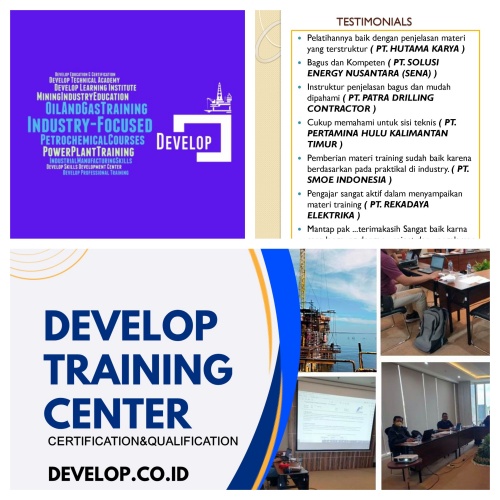
Pelatihan dilaksanakan melalui pemaparan materi dan diskusi interaktif di dalam kelas. Peserta pelatihan didorong untuk berperan aktif dalam memahami materi yang disampaikan oleh instruktur.
DEVELOP mengimplementasikan Syllabus Kelas Metallurgical Principles of Ferrous and Non-Ferrous Metals Training dengan tahap pembelajaran berkualitas sebagai berikut:
Sesi 1-2
- Classification of engineering metals, ferrous versus non-ferrous families and industrial usage
- Atomic structure and bonding, how metallic bonding governs conductivity, ductility, and strength
- Crystal lattice and slip systems, deformation behaviour across BCC, FCC, and HCP metals
- Phase diagrams for alloy design, eutectic, peritectic, and intermetallic compound formation
- Carbon steel metallurgy, carbon content effect on hardness, weldability, and machinability
- Alloy steel metallurgy, chromium, nickel, molybdenum, vanadium contributions to properties
- Stainless steel grades, austenitic, ferritic, martensitic, duplex, corrosion resistance comparison
- Cast iron selection, graphite form influence on damping, wear, and tensile behaviour
- Aluminium alloys, precipitation hardening series, temper designations, and weight-driven applications
- Copper and nickel alloys, conductivity, seawater resistance, and heat exchanger suitability
- Titanium and specialty alloys, strength-to-weight ratio, elevated temperature capability, reactivity
- Case Study
Sesi 3-4
- Alloying element partitioning, carbide formers, austenite stabilizers, and phase balance control
- Heat treatment of ferrous metals, austenitizing, quenching media, tempering response, distortion control
- Heat treatment of non-ferrous metals, solution treatment, artificial aging, annealing cycles
- Mechanical testing interpretation, tensile, impact, hardness, and creep results across alloy families
- Corrosion behaviour comparison, galvanic series, pitting resistance, chloride attack susceptibility
- Elevated temperature performance, creep resistance, oxidation resistance, thermal fatigue limits
- Welding metallurgy differences, ferrous versus non-ferrous fusion zone and heat-affected zone behaviour
- Metallurgical defect identification, inclusions, porosity, decarburization, sigma phase, sensitization
- Failure diagnosis by alloy family, fatigue, overload, corrosion-assisted cracking, embrittlement
- Material substitution evaluation, property equivalence, cost, availability, and fabrication impact
- Specification verification for piping, valves, fasteners, and pressure-retaining components
- Case Study
Sejalan dengan teori yang disampaikan, sebanyak mungkin akan disertakan contoh-contoh studi kasus yang relevan dengan kondisi industri saat ini. Peserta juga diberikan kesempatan untuk mengajukan pertanyaan dan mendiskusikan topik-topik yang dibahas.

Materi Training dirancang khusus oleh para praktisi dan tenaga ahli yang kompeten serta telah berpengalaman sesuai dengan experience dan solid knowledge mereka. Anda akan mendapat sharing ilmu langsung dari para praktisi yang berpengalaman bertahun-tahun.
Selama training, instruktur kami akan menggunakan kombinasi teori serta praktek langsung dengan studi kasus telah dipersiapkan yang menyerupai Proyek nyata.

alloy selection trainingaluminium alloy trainingcast iron propertiescorrosion resistance metalsferrous metals trainingmaterial defect diagnosismetallurgical failure analysisnon-ferrous alloys coursePhysical Metallurgystainless steel metallurgywelding metallurgy course
Other Important Skills to Boost Your Career: